One of my favourite books about writers and writing is How I Write, The Secret Lives of Authors (I talked about it a while back, over on the Book Slam website). It lets you in on the curious ways that different writers entice themselves to work - from talismans to rituals, inspiration takes all forms. My own writing room is rich in encouragement, it blazes with colour, every surface patched with pictures and postcards and objects that create a sense of creation. My mum's hand-stitched blankets adorn the sofa, examples of my dad's art pepper the walls, and I've framed some of my favourite printed mentions for The Book of Summers - Grazia and Marie Claire lay-outs, a piece I wrote on childhood holidays. I've made a space that makes me want to get down to work, and that, beyond aesthetics or sentimentalism, is the most important thing. But sometimes specific work requires specific motivation. I've written before about my mood board making tendencies, whether an elaborate form of procrastination or not, they do it for me. I like creating a visual sense of what I'm writing towards, and I do the same sonically, making soundtracks for my books, playing the same tunes over and over as I tap into a mood. With The Book of Summers, there was one particular photograph that I returned to again and again. It wasn't a holiday snap from a Hungarian adventure, but a picture of an eight-year-old me, standing in my grandparents' garden in Northamptonshire. I've got a blunt-cut fringe and red dungarees and I'm right up in the foreground of the shot, everything else falling away behind me. I seem both aware, and unaware, of the camera's presence. This is the picture I propped on my desk through the writing of my first novel. I looked at that little girl, and tried to think as she might. In The Book of Summers, the figure of Erzsi isn't me, but many of the things that we do have in common come from my dialogue with that photograph.
As I was writing A Heart Bent Out of Shape, inspiration was everywhere. A wonderful bank of memory from my year living in Lausanne, as well as plenty of photos from that time. The books of Ernest Hemingway, particularly A Moveable Feast and A Farewell To Arms. Vintage traveller pictures and postcards, Riviera and snowscape living. Haunting music, from a wounded Johnny Cash to a whispery French Nouvelle Vague. Then one day I looked up from my desk and stared directly into a face. A face that had been watching over me for months, as I struggled my way through first and second drafts, edits, rewrites, scribblings-out and scribblings-back-in. In that face, I suddenly saw my whole book.
I first came across the work of Jason Brooks years ago, on a series of Hedkandi album covers. His illustrations had a clear-lined elegance, a sexiness, an unashamedly aspirational quality that made them different to anything I'd seen before. Back when was I working in an advertising agency in the early 2000s, I suggested his work for a client's campaign and felt such a thrill when they went for it. We commissioned new illustrations, animated them for TV, blew them up huge for billboards and the backs of buses. Even then Jason's work was being copy-catted everywhere, and to work with the man himself lent an integrity not always found inside the often derivative world of advertising. Now, the 'Jason Brooks woman' is practically a school of illustrative style in its own right; relentlessly imitated, rarely if ever equalled. My Jason Brooks print is a souvenir from my past, his agent gave it to me after we'd finished working together. It hangs on the wall in my writing room, just as it's hung on the wall in all the houses I've lived in in the last ten years. Only one day I looked up and saw something different in it. I saw Hadley and Kristina, and in that snow-filled landscape were all the things I hope are in the story of A Heart Bent Out of Shape; a sense of promise, of sparkle, of unease, of loneliness, of hope, of elegance. Light and dark and light again. Jason Brooks' wintry woman turned out to be my own peculiar kind of guardian angel, and as I wrote my way to my final manuscript, I did it under her watchful, level, ever-so-serene gaze. And when I finally finished, I raised a glass to her as well.
Wednesday, 31 July 2013
Monday, 8 July 2013
A Heart Bent Out of Shape - the cover
I'm very happy to be able to share with you the beautiful cover for A Heart Bent Out of Shape...
I think it captures the novel's mood perfectly, and come September 12th, you'll be able to be the judge of that too. For a closer look, and to read the cover copy, go HERE.
North American readers, it'll be published as The Swiss Affair in February 2014, and I'm looking forward to being able to share the equally gorgeous cover for that edition too.
I think it captures the novel's mood perfectly, and come September 12th, you'll be able to be the judge of that too. For a closer look, and to read the cover copy, go HERE.
North American readers, it'll be published as The Swiss Affair in February 2014, and I'm looking forward to being able to share the equally gorgeous cover for that edition too.
Monday, 1 July 2013
Ghana Must Go - a review
After sending an effusive post-holiday tweet to my friend, Kate Haines, extolling the virtues of Taiye Selasi's Ghana Must Go, she suggested that I review it for her blog, Africa In Words. Kate, together with four other PhD students concerned with literature, print culture, and Africa, set the site up in order to 'start community and dialogue' among people with 'similar preoccupations and interests'. I was delighted to be let loose as a guest contributor... and you can read what I thought of Ghana Must Go HERE.
As an author, I think I'd always approach review-writing requests with much caution, my guiding ethos being something along the lines of 'if you've got nothing good to say, say nothing'. In the case of this novel, I had plenty of good things to say, and am therefore very happy to have been given the chance to say them loudly, in an environment that's as well-informed, and super-engaged, as Africa In Words. Thanks, Kate!
Wednesday, 26 June 2013
The wonderful world of work in translation
I might be starting work on
my third novel, and excitedly/ anxiously waiting for my second to be published,
but my first has never been far from my mind this summer. Every so often a
delivery van will pull up outside my house and I’ll sign for a box of books.
Nyarak Könyve. Somrenes Bok. Sommarboken. I’ll tear open the packaging, delight
in the different looks and feels, flick through the pages and see my words in a
foreign language, and then pop a copy on the shelf, for ‘when I’m old and grey
and full of sleep’. In the last couple of months, The Book of Summers was published for the first
time in Hungary, Sweden, Norway, and Holland. In 2012 it came out in Spain,
Italy, and Portugal. In 2014, it’ll be out in Germany.
I find these
translations hugely exciting, not least because they’re destined to always
remain something of a mystery to me. Each version, whether it’s Het boek van de
zomers or El Libro de los veranos, is a new
version in its own right, and holds its own secrets. It is a collaborative work, and is the result of much labour - labour that isn’t lost
on me. While perhaps I’ll never be able to appreciate at first-hand their subtleties, the delicate details within their pages, I figured that the next best thing
I could do was to talk to the author of one such translation. Mónika Mesterházi, who
turned my novel into Nyarak Könyve, kindly agreed to give me a peek inside her
writing world.
Before interviewing Mónika,
I caught up with my Hungarian editor, Vera Tönkő from Park. Vera explained how important it is for her to keep up to date with the work of different translators, so she knows who
best to call upon when the time comes. Revealing her sensitivity as an editor,
she talked about how vital it was that a translator responds positively to a
book, that they ‘love its world’. If any aversions are voiced, Vera will place
the job elsewhere. She likes to work collaboratively with translators, sharing thoughts and notes and getting to know each other’s viewpoints, but ‘the last word always
belongs to the translator’. With The Book of Summers, Vera thought straightaway
of Mónika Mésterhazi, ‘one of the best English translators working in Hungary
today’, and known for her ‘fastidious search for the right word, and the
graceful sentence’. Mónika has translated the work of Alice Munro, Rose Tremain
and Seamus Heaney, and has ‘a good feeling for lyrical texts’, no doubt
stemming from her parallel life as a significant Hungarian poet. When Vera told me this I was delighted - Nyarak Könyve couldn't be in better hands.
An interview with Mónika Mesterházi (via email)...
How did you come to be a literary translator?
At university I attended a seminar for literary
translation, where we learnt all sorts of skills through translating short
pieces of fiction or poems. Most of all it became clear that those working on
the same text are colleagues (possibly friends), even if one criticizes and
edits the version of the other. One of the best seminars I ever had was
led by the late István
Géher, a legendary professor, a poet and translator. While Mr. Géher was
reading out a group member’s translation, the others were to listen and judge
it first by ear, then on paper, as short extracts were handed out and we edited
them together. It was always more than just translation, and was such fun that
many of us attended the seminar for years on.
What is your working process when you embark upon a
new translation?
I always begin with reading the novels I translate so
that the narrative voice can start working in my mind or ear by the time I sit
down in front of my laptop. After reading a novel through, I always read the pages
I plan to do that day and, in some way, even the sentences begin to work
themselves into their Hungarian counterparts by the time I actually start
translating them. So the idea is to understand everything (and possibly every
intention) in the original, and move towards the other language. Once I have a
few pages in Hungarian, it is this text I’ll re-read and revise, first after
one night’s sleep, then in the end, after having finished the whole book. Which means a lot of distancing, after a lot of fumbling with the details.
Literary translation, perhaps unlike business
translation, requires that you capture the author's 'voice', how do you work to
achieve that? Is it that particular challenge one of the beguiling aspects of
literary translation?
The voice is indeed the key to the text. The voice of
the narration is just as important as the dialogues of the individual
characters. There is no recipe for how to capture that. This is the actor’s
part of translation, I think, the way an actor assumes a role in a play. I
mean, you add something from yourself, from the way you hear the text in your
head.
When translating, which 'audience' is chief in your
mind, that of the author (regardless of their ability to understand your
language), or that of the translation readership?
If one does it properly, then the translation can stay
true to its author and at the same time be re-worded for its new audience.
What are the most important attributes for a good
translator, beyond linguistic knowledge?
One has to have linguistic skills (in both languages),
empathy (to be able to see into and beyond the text), and have to be creative
in finding the actual solutions. There are always the so called untranslatable
puns that must still be translated or substituted with something from the same
material. And they are not always “puns”, but expressions, collocations,
linguistic references in the original text which are obviously different in the
translation’s language. And there are the so called cultural gaps… And there
is, of course, the other skill of dealing with time, in the short and the long
run.
Did The Book of
Summers present any particular translation challenges?
Maybe more than it is apparent, and more than there
would be for translators working in other languages. As the major part of the
novel takes place in Hungary, there are Hungarian words and sentences in the
original, which are foreign in English, and this foreignness had to be achieved
in the Hungarian. Hungarian words are sometimes explained in the novel
in English, but I had to explain them in Hungarian. The sound of certain
Hungarian words is commented on, whereas they sound natural for the Hungarian ear.
Certain Hungarian experiences (or customs) are described through the
tourist-guest’s eye, and had to be rendered in a way that they should sound
weird for the Hungarian reader as well. The narrator speaks in her mother
tongue, which is English, but in the translation it is Hungarian. However, at
some point she utters Hungarian words, with difficulty. So I had to indicate
this as well (I transcribed Hungarian words with English pronunciation), and
disrupted (so to say) the Hungarian reader’s suspension of disbelief (that this English author is after all
speaking in Hungarian). But
this kind of challenge is worth taking up for such a good book.
What do you think about 'invisible' and 'visible'
translators?
When I read world literature, I always look up the
translator’s name first, and when I quote a foreign literary text in Hungarian,
however short, I mention the translator (I would do that in a blog as well).
But that may be out of professional pride. On the other hand, in reviews or criticism one often finds
the author’s style praised, without any reference to the person who has worded
it for the reader in their mother tongue. So I find it really important that
translators should be remembered, and I must thank you here for this interview. There is a visibility campaign
organised by CEATL (European Council of Literary Translators’ Associations),
which states: “Paradoxically,
this authorship of the translator mostly remains invisible. The better the
translation, the more the reader will have the impression that s/he is reading
the original text. However, if the general reader does not pay attention to the
quality of the translation, translation quality will not be regarded as a
relevant cultural and economic factor. This is why literary translators
desperately need to be culturally visible as authors of their texts.
Only then can they lay claim to a bargaining position that will permit their
work not to be dashed off.”
Finally, what would be your dream translation job? Are
there any novels or poems out there that you're itching to translate?
In Hungary, the proportion of books in translation is
quite high, especially with books translated from English. Classics and 20th
century authors are mostly available in Hungarian. Contemporary writers I often
get to know through translating them… In translating poetry I am freer to
choose (although it is more difficult to publish verse translations, except in
periodicals – publishers in Hungary don’t believe in slim books of poems…). I’d
like to translate more poems by the Irish poet Matthew Sweeney.
***
BIG thanks to Mónika and Vera for sparing the time to let me in on your world, and to all my other international editors, and translators... Isabel Alves, Amaya Basáñez Fernández, Teresa Albanese, Miebeth van Horn, Marianne Mattsson, and Per Kristian Gudmundsen. Your work makes this UK author very, very happy.
Monday, 24 June 2013
Picture-postcard-perfect
Ahead of September's publication of A Heart Bent Out of Shape here in the UK, my publisher has produced some quite gorgeous postcards. They perfectly conjure the part of Switzerland in which the book is set: Lac Léman, a pleasure-seeker's Riviera paradise, with a timeless sense of beauty. While the story takes place in the present day, it's always seemed to me that there are echoes of travel's 'golden age' in today's La Suisse. A Heart Bent Out of Shape is rooted in such landscapes, while Hadley, my heroine, falls in love while studying Jazz Age literature. Mes amis, Welcome to Lausanne...
I love vintage travel imagery - the dreams of far-off climes, the dash of romance, the hyperreal shades - and a quick glance around my writing room shows that these postcards will be very much at home here. Here's a peep at some of the bits and pieces that I like to surround myself with as I'm working...
Glorious chocolate boxes... The chocs have long since gone, but the packaging's too beautiful to chuck away. I actually bought 'Les Moules du Lac' in Lausanne last winter, from a perfect little Chocolaterie...
Vintage ski cards... I wish somebody had invented snowboarding earlier, as I'd love to see some similarly cheeky/ svelte depictions of people standing-sideways...
... and the ultimate in inspirations, this was the mood-board I made while writing A Heart Bent Out of Shape... light on water, jagged peaks... Bon Voyage.
I love vintage travel imagery - the dreams of far-off climes, the dash of romance, the hyperreal shades - and a quick glance around my writing room shows that these postcards will be very much at home here. Here's a peep at some of the bits and pieces that I like to surround myself with as I'm working...
Glorious chocolate boxes... The chocs have long since gone, but the packaging's too beautiful to chuck away. I actually bought 'Les Moules du Lac' in Lausanne last winter, from a perfect little Chocolaterie...
Vintage ski cards... I wish somebody had invented snowboarding earlier, as I'd love to see some similarly cheeky/ svelte depictions of people standing-sideways...
The wrapping paper I couldn't quite bring myself to give away... it's a poster on my wall instead, just behind me as I write...
... and the ultimate in inspirations, this was the mood-board I made while writing A Heart Bent Out of Shape... light on water, jagged peaks... Bon Voyage.
Sunday, 23 June 2013
Edinburgh again, and on being Mimi
Last Thursday at noon, the Edinburgh International Book Festival made its 2013 programme public... and I'm in it. HURRAH! Last year's Edinburgh was my first ever literary festival and I had an absolute ball. This year I'm going to talk about A Heart Bent Out of Shape, and because my event falls a good month before the official publication date, advance copies will be available to Festival go-ers, which makes the whole thing feel, for me, especially exciting.
In a curious case of stars aligning, or just plain old coincidence, I'm appearing with the excellent Lucy Ellmann, who wrote a novel called 'Mimi'. Time for some trivia... Anybody who knows me beyond the pages of this blog, probably knows that Mimi is the name I commonly go by. My older sister coined it when she couldn't pronounce 'Emylia', the name my parents gave me, so I was Mimi in the cradle, and more often than not, I'm Mimi today. I decided to write under Emylia as it somehow felt less frivolous than Mimi, less flighty, but whenever I meet anyone through books and writing, there comes a point when I feel like I have to confess to being also known (generally known) as Mimi. To some, I'm sure it comes across as overly intimate/ slightly daft, like saying 'call me Tiddlywinks' or 'Fifi-foo', but it's not a nickname, it's my name-name. For years, I only heard 'Emylia' at school, from the mouths of teachers and pupils who didn't know me well enough - Emylia was swottish, a goody-two-shoes who always turned her homework in on time and had neat handwriting, whereas Mimi climbed trees, played football, and was a bit of a scruff bag. I never cared much for 'Emylia', but ever since I started writing under it, I feel like it's had a new lease of life. I don't prickle anymore when I hear the name. 'Emylia' no longer conjures timetables, and rigour, clumpy shoes and school ties; instead it's book jackets, and exciting things, and feeling like at 34 I'm doing the thing I love most in the world and feeling tremendously, enormously happy about it. For the first time, my two identities have fused - Emylia, Mimi, it's all good. I'll just have to remember to keep myself in check when the Edinburgh crowd say things like 'I really loved Mimi', or 'what next, after Mimi?' I'll pipe down, and look to Lucy.
To read more about our event, 'Literary Genius and Genius Loci', go HERE.
In a curious case of stars aligning, or just plain old coincidence, I'm appearing with the excellent Lucy Ellmann, who wrote a novel called 'Mimi'. Time for some trivia... Anybody who knows me beyond the pages of this blog, probably knows that Mimi is the name I commonly go by. My older sister coined it when she couldn't pronounce 'Emylia', the name my parents gave me, so I was Mimi in the cradle, and more often than not, I'm Mimi today. I decided to write under Emylia as it somehow felt less frivolous than Mimi, less flighty, but whenever I meet anyone through books and writing, there comes a point when I feel like I have to confess to being also known (generally known) as Mimi. To some, I'm sure it comes across as overly intimate/ slightly daft, like saying 'call me Tiddlywinks' or 'Fifi-foo', but it's not a nickname, it's my name-name. For years, I only heard 'Emylia' at school, from the mouths of teachers and pupils who didn't know me well enough - Emylia was swottish, a goody-two-shoes who always turned her homework in on time and had neat handwriting, whereas Mimi climbed trees, played football, and was a bit of a scruff bag. I never cared much for 'Emylia', but ever since I started writing under it, I feel like it's had a new lease of life. I don't prickle anymore when I hear the name. 'Emylia' no longer conjures timetables, and rigour, clumpy shoes and school ties; instead it's book jackets, and exciting things, and feeling like at 34 I'm doing the thing I love most in the world and feeling tremendously, enormously happy about it. For the first time, my two identities have fused - Emylia, Mimi, it's all good. I'll just have to remember to keep myself in check when the Edinburgh crowd say things like 'I really loved Mimi', or 'what next, after Mimi?' I'll pipe down, and look to Lucy.
To read more about our event, 'Literary Genius and Genius Loci', go HERE.
Thursday, 13 June 2013
Childhood reading - a Book Slam blog
Have you ever re-read a favourite childhood book, as an adult? The other day I picked up The Black Stallion by Walter Farley for the first time in over twenty years, and began it as an 'experiment in reading'. Within pages, it became just 'reading'. I wrote about it for Book Slam, and you can read it HERE.
Tuesday, 4 June 2013
The Big Red Read 2013 - Fiction Winner
I'm DELIGHTED that The Book of Summers has been voted Fiction Winner in The Big Red Read 2013....
Every year, readers from the London borough of Redbridge's thirteen libraries vote for their favourite shortlisted books. The Fiction category had some seriously fine titles in it this year, including Orange and Booker winners and long/short-listers... so... yes, as you can imagine, I'm utterly thrilled to have won.
I'm especially happy that this is a library award, that my book has been borrowed and read and borrowed again, and that those same readers have cared enough to vote. I'm enormously grateful. As a child I had a voracious and unending appetite for books, and our local library in Chudleigh, Devon, was my second home. Without that service I think my parents would probably have struggled to fund my massive book habit (although I was also adept at rifling through old shoes and white elephants at school jumble sales, unearthing bookish gems). When I moved to Bristol in 2007, one of the the first things I did was to join the local library.
I was sorry not to be able to attend the award ceremony, but I'm greatly looking forward to visiting a Redbridge library soon - to browse the shelves, meet some readers, and talk all things Summers. I've also heard rumours of a trophy with my name on it (figuratively, if not literally)... that's just too exciting. Thank you, Redbridge!
Every year, readers from the London borough of Redbridge's thirteen libraries vote for their favourite shortlisted books. The Fiction category had some seriously fine titles in it this year, including Orange and Booker winners and long/short-listers... so... yes, as you can imagine, I'm utterly thrilled to have won.
I'm especially happy that this is a library award, that my book has been borrowed and read and borrowed again, and that those same readers have cared enough to vote. I'm enormously grateful. As a child I had a voracious and unending appetite for books, and our local library in Chudleigh, Devon, was my second home. Without that service I think my parents would probably have struggled to fund my massive book habit (although I was also adept at rifling through old shoes and white elephants at school jumble sales, unearthing bookish gems). When I moved to Bristol in 2007, one of the the first things I did was to join the local library.
I was sorry not to be able to attend the award ceremony, but I'm greatly looking forward to visiting a Redbridge library soon - to browse the shelves, meet some readers, and talk all things Summers. I've also heard rumours of a trophy with my name on it (figuratively, if not literally)... that's just too exciting. Thank you, Redbridge!
Thursday, 30 May 2013
Stratford, Fowey, Hay...
The last few weeks have been beautifully eventful. At the end of April, the day after I returned from Budapest, I took part in the Stratford-upon-Avon Literary Festival. It was my first time in Shakespeare's town, and the venue where my How To Get Published event was taking place - with authors Hilary Boyd and Michelle Heatley - was within the hallowed walls of the Shakespeare Centre, smack next door to the house where Will was born. For the panel we each talked about our different routes to publication, and enjoyed keen questions from an audience that was largely made-up of aspiring writers. That evening, still in Stratford, I had the delight of meeting up with Susan Fletcher, whose incredibly beautiful fourth novel, The Silver Dark Sea, came out last summer. There's no contemporary writer that I admire more than Susan Fletcher. Her prose sings with poetry, and her stories are always intimate, spirited, and soulful. It was such a pleasure to hole up at The Dirty Duck with her and talk all things writing. I rode the train back to Bristol glowing. I mean glowing.
Next up was Fowey Festival (the Du Maurier Festival, as was) in mid-May, and a hugely fun panel with Shelley Harris (author of Jubilee), Ginny Baily (author of Africa Junction), agent Maggie Philips, and chaired by Professor Helen Taylor. Our subject, Confessions of First Novelists, made for lively discussion. It was a treat to be reunited with Helen and Shelley, with whom I so enjoyed Appledore Festival last autumn. Our short stay in Fowey was cram-packed with extra-curricular fun; pitch-black woodland rambles, moon-lit paddling, scones with lashings of cream and homemade jam, sunny strolls alongside the dazzling waters of the river Foy and Readymoney Cove.
All in all the Fowey Festival was a brilliantly scenic and pleasurable experience, made all the lovelier for the Daphne du Maurier connection. Rebecca is a favourite book, and I've long been an admirer of du Maurier's writing. Being in Fowey, the heart and home of so much of her work, was thoroughly inspirational. I'm always interested in writers who set their store by place, and I couldn't resist a touristy stop-off to buy a Daphne postcard. I love the quote on the back; 'Here was the freedom I desired, long sought for, not yet known. Freedom to write, to walk, to wander, freedom to climb hills, to pull a boat, to be alone.' Given my liking for stealing away to scenic spots to write on my own, I'm eyeing Fowey for my next such trip...
From Fowey to Hay, then. My husband and his bro, comic book creators The Etherington Brothers, were appearing as part of the Hay Fever Programme and I got to go along with them. They were hot off a tour with the Scottish Book Trust, meaning that by the time our three days in Hay were up, a whopping 3,700 children had seen their show. My duties at the Festival were solely photographic... The boys had me nip on to the stage to take a snap of their biggest ever live audience - 900 eleven and twelve year-olds. Here's what that looks like...
When I wasn't hanging with Robin and Lorenzo - or meeting some of the very interesting people that a town like Hay throws your way - I was happily lost in the many bookshops, or tucked in a café corner with a notebook, feeling my way into the first pages of what will be my third book. Being out and about the last few weeks has been perfectly inspiring and a whole lot of fun, but now, as we roll towards summer, I'm ready to close the door to my writing room, open up the window, sit down at my desk... and write.
Next up was Fowey Festival (the Du Maurier Festival, as was) in mid-May, and a hugely fun panel with Shelley Harris (author of Jubilee), Ginny Baily (author of Africa Junction), agent Maggie Philips, and chaired by Professor Helen Taylor. Our subject, Confessions of First Novelists, made for lively discussion. It was a treat to be reunited with Helen and Shelley, with whom I so enjoyed Appledore Festival last autumn. Our short stay in Fowey was cram-packed with extra-curricular fun; pitch-black woodland rambles, moon-lit paddling, scones with lashings of cream and homemade jam, sunny strolls alongside the dazzling waters of the river Foy and Readymoney Cove.
All in all the Fowey Festival was a brilliantly scenic and pleasurable experience, made all the lovelier for the Daphne du Maurier connection. Rebecca is a favourite book, and I've long been an admirer of du Maurier's writing. Being in Fowey, the heart and home of so much of her work, was thoroughly inspirational. I'm always interested in writers who set their store by place, and I couldn't resist a touristy stop-off to buy a Daphne postcard. I love the quote on the back; 'Here was the freedom I desired, long sought for, not yet known. Freedom to write, to walk, to wander, freedom to climb hills, to pull a boat, to be alone.' Given my liking for stealing away to scenic spots to write on my own, I'm eyeing Fowey for my next such trip...
From Fowey to Hay, then. My husband and his bro, comic book creators The Etherington Brothers, were appearing as part of the Hay Fever Programme and I got to go along with them. They were hot off a tour with the Scottish Book Trust, meaning that by the time our three days in Hay were up, a whopping 3,700 children had seen their show. My duties at the Festival were solely photographic... The boys had me nip on to the stage to take a snap of their biggest ever live audience - 900 eleven and twelve year-olds. Here's what that looks like...
When I wasn't hanging with Robin and Lorenzo - or meeting some of the very interesting people that a town like Hay throws your way - I was happily lost in the many bookshops, or tucked in a café corner with a notebook, feeling my way into the first pages of what will be my third book. Being out and about the last few weeks has been perfectly inspiring and a whole lot of fun, but now, as we roll towards summer, I'm ready to close the door to my writing room, open up the window, sit down at my desk... and write.
Saturday, 11 May 2013
Unknown and lovely - a Book Slam blog
No sooner have I finished my second book... Well, I'm starting to think, tentatively, about what I'm writing next... and I wrote about how THAT feels for Book Slam... Go HERE to read about winds of inspiration, thought-provoking foxes, and why, when it comes to a blank page and the perilous setting down of first words, it's Hemingway who has the last word.
Wednesday, 8 May 2013
A Heart Bent Out of Shape - sneak peek
My publisher, Headline, have made some quite beautiful proof copies of A Heart Bent Out of Shape. The hardback cover will look a little different, but the feeling evoked by the design - for these advance copies, and the finished thing - is absolutely right. Roll on September, say I...
Thursday, 2 May 2013
Budapest part 2: First Novel Fest
Amidst the wonders of sumptuous cake, dazzling shop windows, and general jaunting about Budapest, I also took part in the European First Novel Festival. The Budapest International Book Festival has been in existence for some twenty years, but the First Novel Fest is somewhat newer (fittingly). This year writers from Bulgaria, Hungary, Holland, France, Italy, Scotland, Slovenia, Switzerland, Slovakia, Finland, Norway, Cyprus, Poland, Portugal, Denmark, Austria, Germany, Czech Republic, Israel, and England (me!) took part. And what a brilliantly eclectic group we were; different ages, backgrounds, concerns, but the shared experience of having recently released our first novels...
The setting for our meets and panels was Millenáris, a cultural centre and green space in the heart of Buda. The site was once home to an electrical factory, and something of this industrial spirit remains, with converted hangars and distinctly urban architecture (and rusted hunks of metal that could have been relics of a bygone era, or the modernest of art, who knows...). Anyway, it was cool. It felt a bit Berlin-y. And over the Festival weekend it was full of book-loving types sitting in the sunshine, beering and coffee-ing, and eating hot coils of sugared bread (Transylvanian 'Chimney Cake'). I also had a glimpse of it by night, after an evening reception for the Festival, where refreshments came in the form of award winning vintages from Hungary's foremost winegrower, and a dazzling buffet that included, amongst many other favourite dishes, a celestially-good Paprika Chicken. By night, the whole park rang with the croaking of frogs, an insanely vociferous chorus. A sound that was only drowned out, momentarily, by a man leaving our party and howling at the moon - the walking embodiment of the tortured artist. Lovely stuff.
Inside two of the main halls, the Book Festival was in full swing, with exhibitors from all over Hungary and Europe, as well as a full programme of events. My publisher Park's stand became our meeting point for the weekend. It was fab to see the stacks of Nyarak Könyve, and I only regret not trying to nab one of the beautiful posters made for the occasion, using one of the Polaroid-style images from the UK hardback. My sunday launch was advertised on the stand, with bunches of gorgeous summer flowers. I was feeling a lot of Park love.
My first event was a panel on the subject of 'family', with writers from Poland, Hungary, Switzerland, Scotland, and Holland, and hosted by writer and critic Zsofia Ban. While our books were wildly different - from magic realism in a Serbian village to a tale of 'waiting' in a Dutch fishing town - we'd all written of family, in some form; fractured family, harmonious family, murderous family, loving family. It made for spirited discussion - luckily for me, the official language of the festival was English - and I couldn't help being humbled by the language skills of the other writers.
On the second day of the Festival I took part in a panel whose only theme was along the lines of 'you're all first time novelists... GO!' It worked brilliantly. The host was charismatic writer András Forgách, and he succeeded in spinning the conversation between all eight of us, ensuring everyone got the time to talk about their experiences, from quitting a job in a Czech McDonalds, to love in the time of French recession, to being a Danish soldier in Afghanistan. We compared stories of sudden inspiration striking (I was playing tennis and heard a seagull - true story), and debated the pros and cons of writing while listening to music (I voted yes - especially if it's the obsessive repeat playing of one album, teenage-style). Being invited to take part in the Festival was a real privilege, and this particular panel was one of the most enjoyable events I've ever done.
Gurning, between far more composed writers Cathrine Riebnitzsky and Jessica Gregson.
In a pause between interviews and events, Éva and Vera asked if I'd like a peek inside the Park offices, as they were located just a short walk from the Festival site. Steps from Millenáris Park, we found ourselves on a peaceful residential street, and stopped at a beautiful turn-of-the-century apartment block, complete with garden path and wooden balconies. I thought we were catching our breath - it was HOT - but no, tucked inside this glorious old building was the Park office, once the former workspace and home of celebrated architect Marcel Komor. Of the many aesthetically lovely things about my publisher's HQ - from the mezzanine galleries, to the shaded balconies, to the parquet floor - the intricately painted wooden ceiling is perhaps the most remarkable.
In every sense, The Book of Summers has found a very nice Hungarian home indeed.
A post-event stroll across the Margit Bridge, in Budapest's evening sun, Danube truly blue.
Monday, 29 April 2013
Budapest part 1: Nyarak Könyve launch
Two weeks ago, The Book of Summers came out in Hungary. Happy timing, as the Budapest International Literature Festival was taking place at the same time, and I was invited over as the English representative in the European First Novel Festival. I'll be writing a whole separate entry on that experience, but for now I just want to tell you about Nyarak Könyve, and how beautifully my Hungarian publisher, Park, launched it in Budapest.
After being met at the airport by the lovely Éva, we sped into the city by taxi, windows down, sun beaming, talking over the schedule for my stay. My husband and I arrived at our hotel in the late afternoon, and were greeted by this...
If you've read The Book of Summers, and have a particularly keen eye for cake, you might recognise it as a Dobos Torte; a favourite Magyar cake possessed of a topping that in the book I describe as a 'toffee coloured skating rink'. Or, as the non-English cake baker suggests, 'scating risk', which sounds infinitely more daring. What a lovely sight, especially as it was presented with a copy of my book in Hungarian and a welcome note from my editor, Vera. We made coffee, cut huge slices, and sat on our balcony, basking in the Budapest sunshine.
Fabulous Team Park: Vera and Éva and I
Sunday 21st was the launch event for Nyarak Könyve. It took place at the main site of Budapest's book festival, and it was great to see just how many people came along - maybe they were curious to see how this semi-outsider had written about Hungary. The format for the event was fab: I was interviewed by eminent cultural commentator and TV journalist Balázs Lévai (with the help of a very lovely interpreter, who relayed our conversation to the audience), while renowned Hungarian actress Annamaria Láng read sections from the book. Actually read feels like an understatement, she performed them, with such subtlety and grace that even though I couldn't understand a word (perhaps especially because) I was utterly moved. Afterwards I signed books, regrouped with my family (my mum and dad had also joined us in Budapest - joy!), and went for beers in the sunshine.
Hanging out at the Fisherman's Bastion, post-launch, a fave Budapest spot
There wasn't a lot of time for sightseeing this time in Budapest, but I did make one pilgrimage. A particularly self-indulgent one, too. I was tipped off that at a downtown bookstore there was a rather fabulous window display. On our last morning we hopped on the metro and got off at Rákoczi Street, home to the brilliantly named Libri Könyvpalota (Libri Book Palace). I spotted this from afar...
... move closer...
... and closer still...
It's far easier being unselfconscious when you're abroad, but I didn't even try to pretend to take it in my stride. Pointed. Stared. Posed. If a passer-by finds it one hundredth as head-turning as me it'll have done its job supremely.
It was always going to be a special trip, seeing my words in Hungarian for the first time, and taking part in the Festival with my family there too, but the experience surpassed all expectations. Much of that was down to the kindness and enthusiasm of Park, who looked after me (and my book) so well - Nyarak Könyve couldn't be in better hands. As well as the excitements of the launch, my time in Budapest was made of so many memorable moments. April snows turning to blistering sunshine just before our arrival. White light falling over the Danube at dusk. A driving tour with Éva and András, Park's MD, along the tree-lined serenity of Andrássy Útca, past skateboarders turning tricks at Heroes' Square, and into the green suburbs, for dinner in a garden restaurant. A saturday morning stroll on Margit Island, just steps away from our hotel, a place thronged with pleasure-seekers, tots on trikes and body-beautiful Magyars. Feeling that deep city heat that I love so much - river glittering, pavement cafes bursting at their seams - knowing that summer's on its way. That maybe, in Hungary and with Nyarak Könyve, it has, in fact, already arrived. A huge Köszönöm szépen to all at Park.
Monday, 1 April 2013
Breathtaking
Back in the summer I wrote about the perils of Holiday Reading for Book Slam. I talked about 'Environmental Mismatch', when your chosen book is all out of kilter with your holiday destination. For last week's snowboarding trip to Austria, I packed a surf story. Tim Winton's BREATH is set over a sequence of endless summers, on the other side of the world. Its pages are steeped in sun and salt water. At one point the following exchange takes place: 'I've never seen snow, I said. White, she said. And cold.' A good book for a winter trip, then? It turned out to be the best. The very best. In fact, I don't think I've ever had a more perfect holiday reading experience.
I first came across Tim Winton when I heard his coastal memoir, Land's Edge, read on Radio 4 last year. BREATH, Winton's 2008 novel, is a sea song of tough beauty, ceaselessly poetic, never less than controlled. It's a coming-of-age story, tinted with nostalgia, joy, and deep dark regret, and imbued with passion for the extraordinary (never 'extreme', Winton tells us) sport of surfing. The most stunning passages take place on the water, and the book succeeds in leading us all the way into a specific experience and making us understand and feel every single aspect of it. I can imagine the book is no less of a powerful read for those who've never stood sideways (through surf or skate or snow), but if you've had a taste of it - no matter how fleeting, or how diluted, compared to the protagonist Bruce Pike's experience - the effect is all the stronger. And if you're getting up every morning as I did last week, taking your board and heading into the white world of the mountains, BREATH's poetry ringing in your ears, and spurring your every powder turn or swift descent, the line between book life and real life criss-crosses in beautiful, breathtaking, fashion.
Tim Winton's writing is tinglingly good. There are three passages in the book that make me cry every time I read them (even on a casual flick - I know, I've tested it), and it's not because they're sad - it's because they're perfect. I've never known the intoxicating, addictive fear that Winton writes of, nor the extremity of Pikelet's experiences on a surf board, but I get it. I've always got it. He calls surfing dancing, and as I read, I know I've danced too. I learnt to snowboard when I was nineteen and living in Switzerland. I can remember almost everything about that first day in early December. It was made of 'bluebird and pow' - blue skies, fresh snow - I knew it was beautiful, I didn't figure it for rare. Maybe I thought all days on the mountain were like that; untouched, and above the clouds. We hired boards in the village and went up without an instructor, falling our way chaotically down the hill. The colour-coding of slopes meant nothing to us (only now do I know that the first run I rolled down was Red), and we had none of the restraint of orderly ski school snakes. I was out of control, cartwheeling, a rag doll on a runaway board. When I got home I cried in the shower as the water hit my still-screaming muscles. The next morning I woke up back in my student lodging feeling as though I'd been hit by a car. I struggled to turn my head or lift an arm to switch off my bleating alarm. I lay still, stretching out my fingers and my toes, every part of me aching in a way it never had. For all the pain, I already knew I loved everything about le surf. Fifteen years of snowboarding holidays later, including two season-long trips, and just a single winter missed (I was finishing writing The Book of Summers) and I love it still.
On last week's trip, more than ever before I examined how I feel about snowboarding. That was the BREATH effect - no matter that it was snow not surf - it's an act that is every bit as 'completely pointless and beautiful'. I've never been one of Winton's grommets or 'hell men', but for a while back there, when I lived in the mountains, I was swept up in the season's buzz - I wanted to ride faster, jump higher - progression was everything, and daring yourself to do the things you were afraid of was part of it. Last week I guess I accepted that now I'm more of a daytripper, and it's the romance of the ride that I appreciate the most. Haring down twisting, pine-lined paths, catching the biting scent of woodsmoke, sticking my board in the snow and watching the view. My husband, however, is still fuelled by that nip of fear, and the thrill of over-coming it. Last week he dropped into the park, flying off too-big kickers and clattering his board over slick and unforgiving boxes, and I watched him do it. I felt a little envious - not of his ability, but of his unending desire to step up and push his luck, knowing that for every smack down, the moments when you ride away with a half-crazed smile are worth it a thousand times over. I always weigh up the risk, and ride within what I see as the bounds of my ability. It's safe, but in its way it's limiting. I know I can change that at any moment, ruefulness is a foolish sort of self-deception, but I also know that I don't really want to. Not now. So I console myself with the words of BREATH's Bruce Pike as he recalls his first wave. Not his biggest, his toughest, his bravest, but his first. He tells us that even now, as an old man, he judges 'every joyous moment, every victory and revelation against those few seconds of living'. Everyone has their own bliss, and perhaps it's about finding it, and recognising it. In life, in memory, or glimpsed through the pages of a graceful, vital story.
I first came across Tim Winton when I heard his coastal memoir, Land's Edge, read on Radio 4 last year. BREATH, Winton's 2008 novel, is a sea song of tough beauty, ceaselessly poetic, never less than controlled. It's a coming-of-age story, tinted with nostalgia, joy, and deep dark regret, and imbued with passion for the extraordinary (never 'extreme', Winton tells us) sport of surfing. The most stunning passages take place on the water, and the book succeeds in leading us all the way into a specific experience and making us understand and feel every single aspect of it. I can imagine the book is no less of a powerful read for those who've never stood sideways (through surf or skate or snow), but if you've had a taste of it - no matter how fleeting, or how diluted, compared to the protagonist Bruce Pike's experience - the effect is all the stronger. And if you're getting up every morning as I did last week, taking your board and heading into the white world of the mountains, BREATH's poetry ringing in your ears, and spurring your every powder turn or swift descent, the line between book life and real life criss-crosses in beautiful, breathtaking, fashion.
Tim Winton's writing is tinglingly good. There are three passages in the book that make me cry every time I read them (even on a casual flick - I know, I've tested it), and it's not because they're sad - it's because they're perfect. I've never known the intoxicating, addictive fear that Winton writes of, nor the extremity of Pikelet's experiences on a surf board, but I get it. I've always got it. He calls surfing dancing, and as I read, I know I've danced too. I learnt to snowboard when I was nineteen and living in Switzerland. I can remember almost everything about that first day in early December. It was made of 'bluebird and pow' - blue skies, fresh snow - I knew it was beautiful, I didn't figure it for rare. Maybe I thought all days on the mountain were like that; untouched, and above the clouds. We hired boards in the village and went up without an instructor, falling our way chaotically down the hill. The colour-coding of slopes meant nothing to us (only now do I know that the first run I rolled down was Red), and we had none of the restraint of orderly ski school snakes. I was out of control, cartwheeling, a rag doll on a runaway board. When I got home I cried in the shower as the water hit my still-screaming muscles. The next morning I woke up back in my student lodging feeling as though I'd been hit by a car. I struggled to turn my head or lift an arm to switch off my bleating alarm. I lay still, stretching out my fingers and my toes, every part of me aching in a way it never had. For all the pain, I already knew I loved everything about le surf. Fifteen years of snowboarding holidays later, including two season-long trips, and just a single winter missed (I was finishing writing The Book of Summers) and I love it still.
First ever day on the mountain, in 1998. I'm the one on the right - bad style, big smile.
On last week's trip, more than ever before I examined how I feel about snowboarding. That was the BREATH effect - no matter that it was snow not surf - it's an act that is every bit as 'completely pointless and beautiful'. I've never been one of Winton's grommets or 'hell men', but for a while back there, when I lived in the mountains, I was swept up in the season's buzz - I wanted to ride faster, jump higher - progression was everything, and daring yourself to do the things you were afraid of was part of it. Last week I guess I accepted that now I'm more of a daytripper, and it's the romance of the ride that I appreciate the most. Haring down twisting, pine-lined paths, catching the biting scent of woodsmoke, sticking my board in the snow and watching the view. My husband, however, is still fuelled by that nip of fear, and the thrill of over-coming it. Last week he dropped into the park, flying off too-big kickers and clattering his board over slick and unforgiving boxes, and I watched him do it. I felt a little envious - not of his ability, but of his unending desire to step up and push his luck, knowing that for every smack down, the moments when you ride away with a half-crazed smile are worth it a thousand times over. I always weigh up the risk, and ride within what I see as the bounds of my ability. It's safe, but in its way it's limiting. I know I can change that at any moment, ruefulness is a foolish sort of self-deception, but I also know that I don't really want to. Not now. So I console myself with the words of BREATH's Bruce Pike as he recalls his first wave. Not his biggest, his toughest, his bravest, but his first. He tells us that even now, as an old man, he judges 'every joyous moment, every victory and revelation against those few seconds of living'. Everyone has their own bliss, and perhaps it's about finding it, and recognising it. In life, in memory, or glimpsed through the pages of a graceful, vital story.
Wednesday, 6 March 2013
Paean to paper
After writing last time about keeping a diary, what of the notebooks themselves? While my Writing Diary is an unromantic Word document, I have an ever-increasing collection of notebooks, some of which I can't bring myself to write a word in. They're simply... too lovely. Let me take you on a photo-tour of just some of the yet-to-be-spine-cracked notebooks currently occupying my desk, and others that I only seem bold enough to write in when I'm abroad. Perhaps there's something about the sense of rejuvenation and discovery that makes a beautiful notebook the perfect travelling companion. New climes, clean sheet.
These are top of my 'too gorgeous for words' pile. Vintage traveller, cloth-bound, Liberty print... it'd take a brave writer to start scribbling in their pages. Perhaps 2013 will be the year.
I've a penchant for most things French, including these old school style jotters. With their wafer thin paper and scant pages you'd think they'd retail at just a few centimes... mais non... which is probably why I keep them for best. 'Au cerf' contains early notes on The Book of Summers, but it wasn't until I was on a lakeside holiday in Hungary that I dared to jot in it.
Girl meets boy. Ryan Gosling, actually. The one on the left is too lovely, and the one on the right too silly, and neither contain so much as a scribble. Yet.
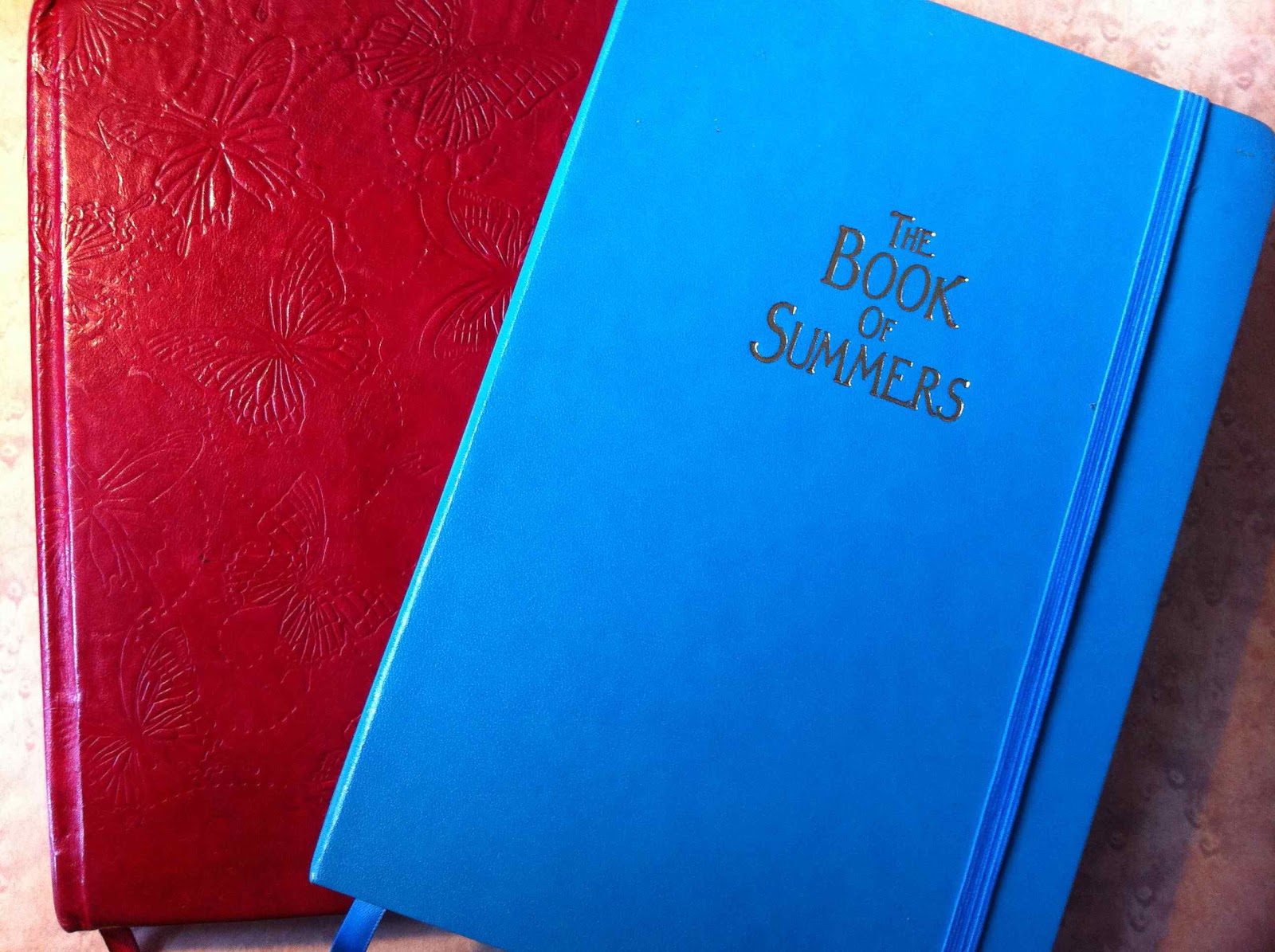
These I file under Precious Notebooks or Leather-bound Lovelies. The red one was a gift from my mum, it's delicately printed with butterflies and came all the way to Rwanda with me. A six hour delay in Nairobi airport flew by as I wrote up our travels in it, wholly occupied in trying to find words for sights and experiences that left me mostly speechless. On the last page I've listed handy Kinyarwandan phrases and phonetic pronunciations. I can remember writing them down one balmy night on the shores of Lake Kivu, with our dear friends Steve and Kate and their driver, friend, and best Kinyarwandan teacher Claude. And the blue... a very limited edition notebook made by the brilliant Headline. It took a trip to Italy for me to write a word in it; a messy brainstorm for titles for my second novel. Maybe I thought The Book of Summers would bring it luck.
Right now, with my second novel finished, my mind is buzzing with new ideas about what to write next. New words deserve new notebooks. My current stationery crush is on Rifle Paper Co. I discovered their notecards in Anthropologie and I've now got my heart set on their delicious Botanicals journals (above). No listless scribbles or meandering To-Do lists for those pages. If I ever dared to put pen to their paper, I like to think I'll be writing something beautiful. Or at the very least, be writing somewhere beautiful. I need to plan a trip.
These are top of my 'too gorgeous for words' pile. Vintage traveller, cloth-bound, Liberty print... it'd take a brave writer to start scribbling in their pages. Perhaps 2013 will be the year.
I've a penchant for most things French, including these old school style jotters. With their wafer thin paper and scant pages you'd think they'd retail at just a few centimes... mais non... which is probably why I keep them for best. 'Au cerf' contains early notes on The Book of Summers, but it wasn't until I was on a lakeside holiday in Hungary that I dared to jot in it.
Girl meets boy. Ryan Gosling, actually. The one on the left is too lovely, and the one on the right too silly, and neither contain so much as a scribble. Yet.
These I file under Precious Notebooks or Leather-bound Lovelies. The red one was a gift from my mum, it's delicately printed with butterflies and came all the way to Rwanda with me. A six hour delay in Nairobi airport flew by as I wrote up our travels in it, wholly occupied in trying to find words for sights and experiences that left me mostly speechless. On the last page I've listed handy Kinyarwandan phrases and phonetic pronunciations. I can remember writing them down one balmy night on the shores of Lake Kivu, with our dear friends Steve and Kate and their driver, friend, and best Kinyarwandan teacher Claude. And the blue... a very limited edition notebook made by the brilliant Headline. It took a trip to Italy for me to write a word in it; a messy brainstorm for titles for my second novel. Maybe I thought The Book of Summers would bring it luck.
Right now, with my second novel finished, my mind is buzzing with new ideas about what to write next. New words deserve new notebooks. My current stationery crush is on Rifle Paper Co. I discovered their notecards in Anthropologie and I've now got my heart set on their delicious Botanicals journals (above). No listless scribbles or meandering To-Do lists for those pages. If I ever dared to put pen to their paper, I like to think I'll be writing something beautiful. Or at the very least, be writing somewhere beautiful. I need to plan a trip.
Wednesday, 27 February 2013
Notes to self - a Book Slam blog
Thursday, 7 February 2013
Feeling strange
In Changing My Mind, Zadie Smith's excellent collection of essays, the author talks about the feeling of finishing a novel. 'Who can find anything bad to say about the last day of a novel?' she writes, 'It's a feeling of happiness that knocks me clean out of adjectives'.
After living in a cocoon of editing for most of January, I sent my novel off to my editors on Friday. Was this the 'last day' that Smith writes about? Sort of. My manuscript and I have gone through two rounds of notes, and all that remains now are copy edits for UK and US. Do I feel so happy, like Smith, that I'm lost for adjectives? Not quite. Above all, I feel a little bit... strange. I've tried to dissect this feeling further, as I too expected out-and-out ecstasy, at least a bit of heel kicking and capering, but instead I poured a large glass of wine, sank into a bath, turned up my music loud enough to annoy the neighbours, and... felt strange.
Strange... because it's Lausanne. Back in November 2011, just as I was really getting stuck into the writing of A Heart Bent Out of Shape/The Swiss Affair, I wrote a blog about my 'golden city', the place I lived for a year while at university and have loved ever since. My story is set in Lausanne, and throughout its writing I felt the immense joy, and the considerable responsibility, of committing to paper a place that has lived in one's imagination for so long. Lausanne isn't just a setting for a novel, a city plucked from Google Maps, and researched through Wiki, it's LAUSANNE. A name I cannot see or say or hear without feeling the prickle of lust usually reserved for lovers. I was nineteen when I went to live there for the year. Have you ever longed for something and then when it eventually happens you discover that it's even better than your imaginings? I don't think that happens too many times in a lifetime, but it happened to me when I first went to Lausanne. After a golden year in a golden city I've returned again and again and it's always and never the same. I doubt I'll ever write another novel set in Lausanne, so this is it... Have I done it justice on the page? Along the way I've weeded out so much, because I've realised that just because it lives in my memory it doesn't mean it matters to the story. Slain darlings? You bet. One of the best things about writing is that you can take the things that you love, the things you hold dear, and make something new out of them. But a story built of cherished things is especially hard to let go of, and maybe that's why I feel... strange.
Strange also because... of my characters. The people I've made up and who are, now, as real to me as anyone I know. Hadley and Joel and Hugo and Kristina... Have I told their story with 'all the truth and tenderness and severity' I'm capable of, as Katherine Anne Porter so perfectly says? God, I hope so. That moment when your characters finally feel fully-formed, a potent mix of pride and responsibility hits; the desire to do your best by them, and the hope that they'll go out into the world and be looked upon kindly, and be understood. There's some reconciling to be done too, between how they seem to me, the doting mother, and how they appear on the page. A final once-over, a kiss on the head, then out into the world.
So after finishing on Friday I felt strange on saturday and I felt strange on sunday and on monday I went to London and met lots of people and talked about the new book and began to feel more and more excited about it but, also, still strange. Today, as I write, I feel good. I'm sitting at my desk, wearing the same holey pink cardigan and listening to the same album that were my constants through the last month of writing but... something's missing. I don't have a 100,000 word document open. I'm not scribbling notes. I'm no longer trying to change the fates of people I've made up but are no less beloved for it. Soon I'll be checking copy edits, I'll see a cover, hold a proof in my hands, and then the book itself. But for now? It's still a little strange, and maybe I'm just learning that that's the way I like it.
After living in a cocoon of editing for most of January, I sent my novel off to my editors on Friday. Was this the 'last day' that Smith writes about? Sort of. My manuscript and I have gone through two rounds of notes, and all that remains now are copy edits for UK and US. Do I feel so happy, like Smith, that I'm lost for adjectives? Not quite. Above all, I feel a little bit... strange. I've tried to dissect this feeling further, as I too expected out-and-out ecstasy, at least a bit of heel kicking and capering, but instead I poured a large glass of wine, sank into a bath, turned up my music loud enough to annoy the neighbours, and... felt strange.
Strange... because it's Lausanne. Back in November 2011, just as I was really getting stuck into the writing of A Heart Bent Out of Shape/The Swiss Affair, I wrote a blog about my 'golden city', the place I lived for a year while at university and have loved ever since. My story is set in Lausanne, and throughout its writing I felt the immense joy, and the considerable responsibility, of committing to paper a place that has lived in one's imagination for so long. Lausanne isn't just a setting for a novel, a city plucked from Google Maps, and researched through Wiki, it's LAUSANNE. A name I cannot see or say or hear without feeling the prickle of lust usually reserved for lovers. I was nineteen when I went to live there for the year. Have you ever longed for something and then when it eventually happens you discover that it's even better than your imaginings? I don't think that happens too many times in a lifetime, but it happened to me when I first went to Lausanne. After a golden year in a golden city I've returned again and again and it's always and never the same. I doubt I'll ever write another novel set in Lausanne, so this is it... Have I done it justice on the page? Along the way I've weeded out so much, because I've realised that just because it lives in my memory it doesn't mean it matters to the story. Slain darlings? You bet. One of the best things about writing is that you can take the things that you love, the things you hold dear, and make something new out of them. But a story built of cherished things is especially hard to let go of, and maybe that's why I feel... strange.
Darling: The comely facade of a Lausanne building.
Strange also because... of my characters. The people I've made up and who are, now, as real to me as anyone I know. Hadley and Joel and Hugo and Kristina... Have I told their story with 'all the truth and tenderness and severity' I'm capable of, as Katherine Anne Porter so perfectly says? God, I hope so. That moment when your characters finally feel fully-formed, a potent mix of pride and responsibility hits; the desire to do your best by them, and the hope that they'll go out into the world and be looked upon kindly, and be understood. There's some reconciling to be done too, between how they seem to me, the doting mother, and how they appear on the page. A final once-over, a kiss on the head, then out into the world.
So after finishing on Friday I felt strange on saturday and I felt strange on sunday and on monday I went to London and met lots of people and talked about the new book and began to feel more and more excited about it but, also, still strange. Today, as I write, I feel good. I'm sitting at my desk, wearing the same holey pink cardigan and listening to the same album that were my constants through the last month of writing but... something's missing. I don't have a 100,000 word document open. I'm not scribbling notes. I'm no longer trying to change the fates of people I've made up but are no less beloved for it. Soon I'll be checking copy edits, I'll see a cover, hold a proof in my hands, and then the book itself. But for now? It's still a little strange, and maybe I'm just learning that that's the way I like it.
Subscribe to:
Posts (Atom)